
Sparrowmania
The House Sparrow Was the Bird America Asked For—and Maybe the One It Deserved

A merciless sun beat down on Philadelphia, and the silver maples that once shaded the city offered no relief. In every tree-lined park and square, a plague of inch-worms had stripped the branches bare before descending on gossamer threads onto the bonnets, dresses, and faces of hapless pedestrians below. It was the summer of 1868, and just like the last few years, Philadelphians were finding any excuse to avoid going outdoors. Even though the sidewalks were slick with the bodies of inchworms trodden underfoot, it felt like the city was at the caterpillars’ mercy.
Nothing seemed to make much of a difference, not planting different trees, not painting their trunks with tar, not even manually scraping away the cocoons. But there was one solution yet to try. New York, too, had recently suffered under the inch worm’s many heels, until several public-spirited citizens had imported house sparrows from England in 1860 and released them in parks throughout the city hoping that the industrious little English sparrows, as they came to be called, would devour the insect pests. And it seemed to have worked—as quickly as the sparrows multiplied, the worms disappeared, and newspapers throughout the country gave the fecund little birds credit.
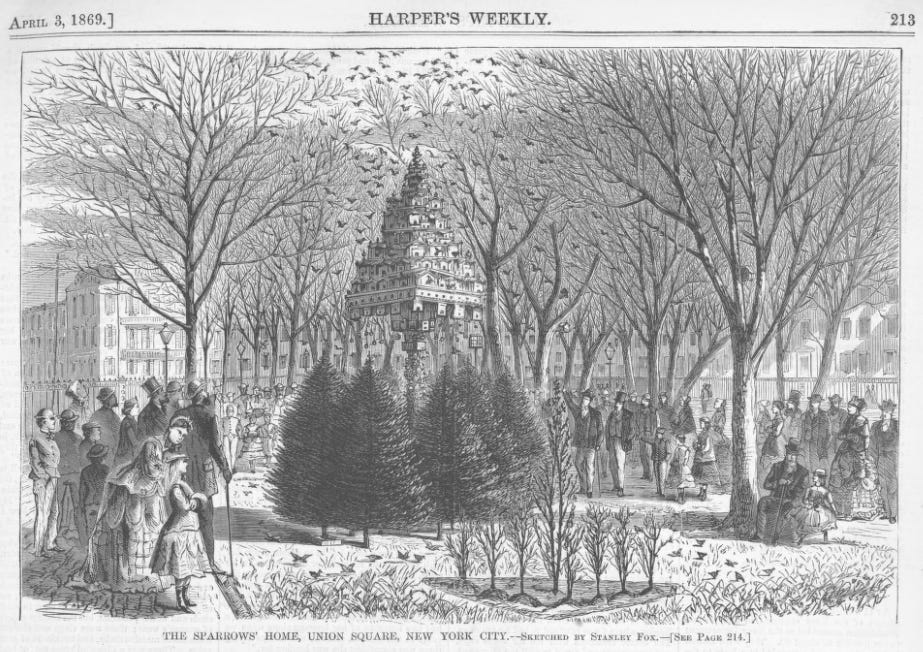
Philadelphia’s City Council reasoned the sparrows were worth a shot, and dispatched John Bardsley back to his native England to bring some back. Arriving in early 1869, Bardsley caught more than a thousand sparrows with the help of a few local boys. When he returned from Liverpool with the birds under his care, the City Council paid him a hundred dollars for his service.1
In advance of the birds’ release, Philadelphians did everything in their power to welcome the sparrows. “Every conceivable luxury was provided for them,” wrote one newspaper, including bird boxes in the parks and feeding stations regularly resupplied by city employees. Finally, the birds were set free in April, and over the following weeks “the newspapers teemed with the doings of the birds.”2
It took a few years for the sparrows to do their job, but by 1872 “not a measuring worm was to be found.” The Philadelphia Inquirer volunteered that the city’s residents would “cheerfully subscribe to a fund for furnishing them with food for the winter, for did they not exterminate the disgusting measure worms that of old stained their light summer hats and left unsightly trails on their pearly-hued coats and snowy vests?” The newspaper concluded that the now-ubiquitous sparrows were “one of the most pleasant features of . . . this vast extent of brick and mortar, known to the world as Philadelphia.”3
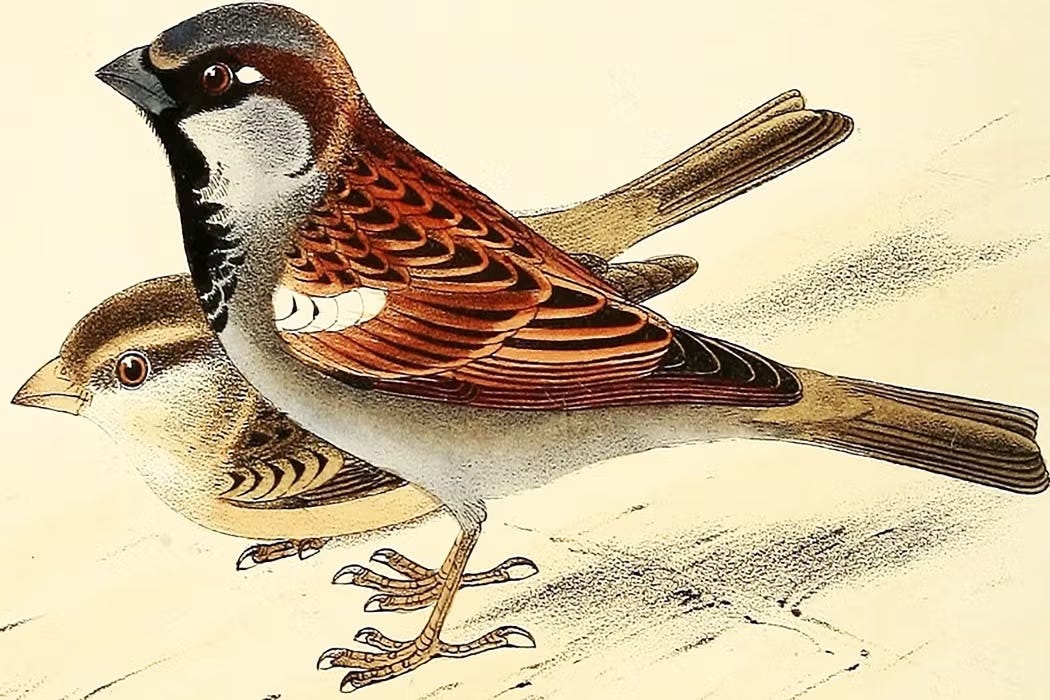
Philadelphia was far from alone. Every city, it seemed, had some grub or caterpillar it would rather do without, and with effective pesticides half a century away, sparrows seemed like the best option available. The same inchworms that infested New York and Philadelphia afflicted the entire Northeast. Taking inspiration from New York, New Haven ordered a shipment of sparrows from England in 1867, as did Boston the following year.
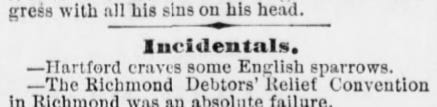
Word of New York’s successes spread quickly through the South. The Galveston Daily News wrote to Central Park’s comptroller to ask about sparrows, hoping that they might also fight the “cotton caterpillar.” Galveston released its first sparrows in 1867. The Atlanta Constitution advised cotton-growers struggling against the army worm “to import goodly numbers of the English sparrow, who hath an unbounded stomach for worms.”4
After grasshoppers ravaged grain crops in Utah, the Deseret News wrote that “a few dozens of these [sparrows] might be imported . . . at trifling expense, and if they did not prove as useful as the gulls did some years ago, in destroying the crickets, they would certainly prove a benefit in destroying the caterpillars.” Salt Lake City released its first sparrows in 1873.5
In Chico, California, one writer suggested that the struggling fruit-growers do “nothing more than what has been done in some of the Eastern States . . . the introduction of the English sparrow . . . will keep an entire orchard clear of pestiferous insects and worms.”6
As far away as Hawaii there were calls to introduce sparrows to fight mosquitoes, which New York’s birds allegedly helped control. The Hawaiian Gazette said that importing two thousand sparrows would do as much for “domestic peace and comfort of our citizens as would the addition of fifty more policemen.”7
Whether sparrows were introduced by public-minded citizens or the city government itself, importing the birds was seen as a municipal project organized in the public’s interest. In Cleveland, one gentleman organized “a club for the purpose of importing sparrows” and invited contributions for the cause, to which The Cleveland Leader added, “a little investment this way would become a public good.” In Lexington, Kentucky, another newspaper praised Major M. C. Johnson and John W. Kearney, Esq. for importing and releasing a few pairs of sparrows “as a matter of public benefit.” And in Brooklyn, New York, a poet voiced his support for the city’s proposal to spend $500 importing another batch of sparrows by writing:8
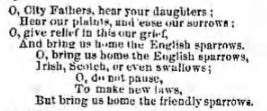
Brooklyn Eagle, December 2, 1861
A mania for sparrows was spreading through the country, only shortly in advance of the birds themselves. One newspaper called it a boom. Many called it a craze. In Kentucky, where citizens pooled their resources to buy a shipment of sparrows, one paper reported, “Louisville seems inclined to rival the famous tulip mania in its English sparrow frenzy. One thousand sparrows have been contracted for, and all the citizens are sparrow mad.” Another deadpanned, “in a short time we expect to see the sparrow stock quoted regularly on the Louisville ‘Change, and that bull and bear movements in the sparrow market will shake that emporium to its financial center. There will be conspiracies and ‘corners’ in sparrows.”9
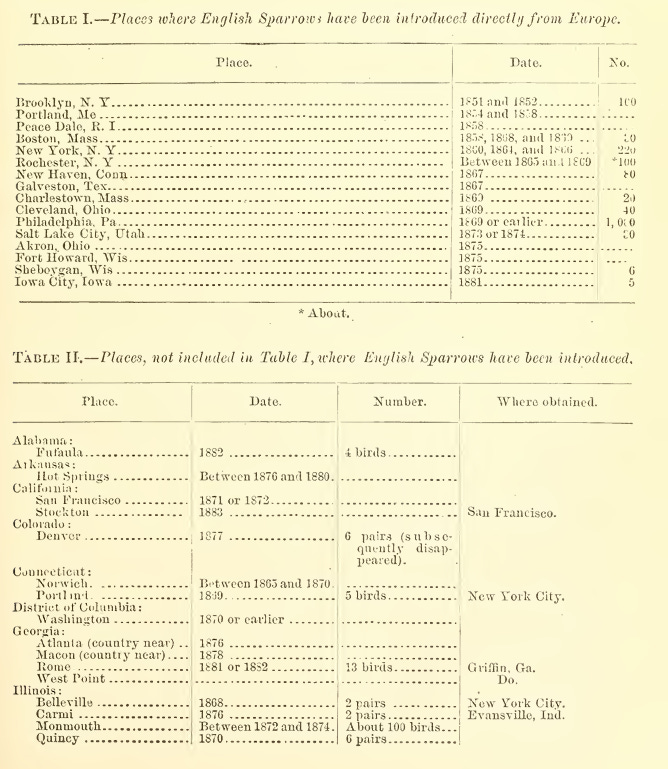
At first, cities made arrangements with individuals or bird importers to bring sparrows over directly from Europe. In 1869 The Charleston Daily News explained that “These pretty and sprightly little birds can be easily imported from Liverpool at an insignificant cost, by any of the steamers of our regular line.” Yet within a few years so many cities were clambering for sparrows that the cost of a single pair reached twenty dollars—equivalent to six hundred dollars today.10
After a few years more, however, the price for sparrows had fallen by three quarters and sparrow boosters no longer needed to go abroad for birds. New York’s sparrows had multiplied so prolifically that “a few hundred at least can be spared every year for dissemination over the country.” Cincinnati got its sparrows from New York City, as did Indianapolis, Topeka, and St. Louis. Soon enough, any city with sparrows was exporting to its neighbors. Erie, Pennsylvania got its sparrows from Philadelphia. Fredericksburg, Virginia got its birds from Richmond. An 1889 review by the U.S. Department of Agriculture identified more than a hundred places where sparrows were introduced and admitted that there were undoubtedly scores more that they’d missed.11
House sparrows did a pretty good job of spreading through the country without much human help. Capable of raising four broods of six chicks every year, sparrows breed fast enough that they only need a few years to fill up a city and start pushing into the countryside. Within fifteen years, the six sparrows released in Memphis, Tennessee had multiplied enough to “infest the city and the suburbs for several miles.”12
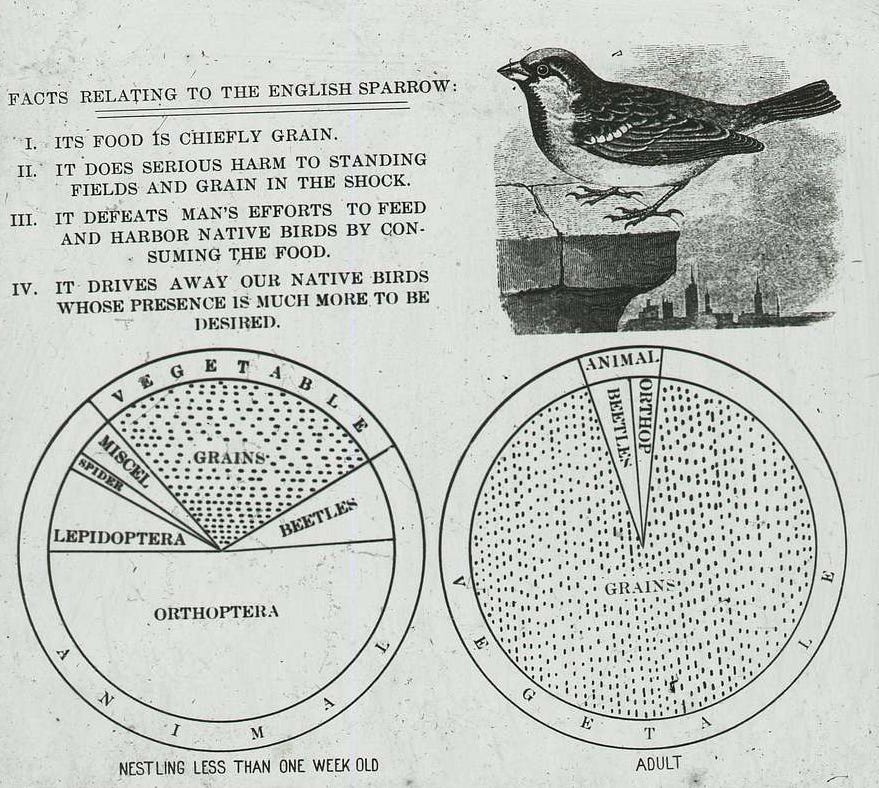
In spite of the universal expectation that sparrows would gobble up every annoying insect, house sparrows are primarily grain-eaters. So it was not grubs or mosquitoes that fueled their growth, but discarded oats, corn, wheat, and barley pecked from the ground, above all from the horse manure that piled up on every city street. One estimate put the proportion of their diet gleaned from horse droppings at ninety percent.13 All of the birdhouses and feeding stations put up at public expense were hardly necessary—horses gave them all the food they could want, and every drain pipe, eave and cranny in the built environment made for a perfect nesting location.
Sparrows spread from town to town by following the trail of spilled grains left by train cars carrying wheat, sometimes even inadvertently hitching a ride in empty box cars before being released hundreds of miles down the track. But the natural spread of the birds wasn’t nearly quick enough for Americans desperately watching their crops disappear under an onslaught of bugs. Since “the sparrow does not ‘emigrate’ fast enough, nor in sufficient force, to save the fast declining fruit crops,” wrote one Vermont newspaper, humans had to help the birds along.14
In 1873, as the sparrow craze was cresting, Washington D.C.’s Evening Star concluded, “nearly every city in the Union has its colony of English sparrows now.” In the small town of Oxford, Ohio, sparrows were “spreading from farm to farm in every direction” by 1886. In Binghamton, New York, the sparrow was “no longer a city resident, but is finding his way to the small villages, and already is at the farmer’s houses eight and nine miles in the country.” Outside of Lancaster, Pennsylvania, the sparrow “has also made its appearances at all the villages and farm-houses.” Sparrows following grains dropped by muletrains had even established themselves in Death Valley.15
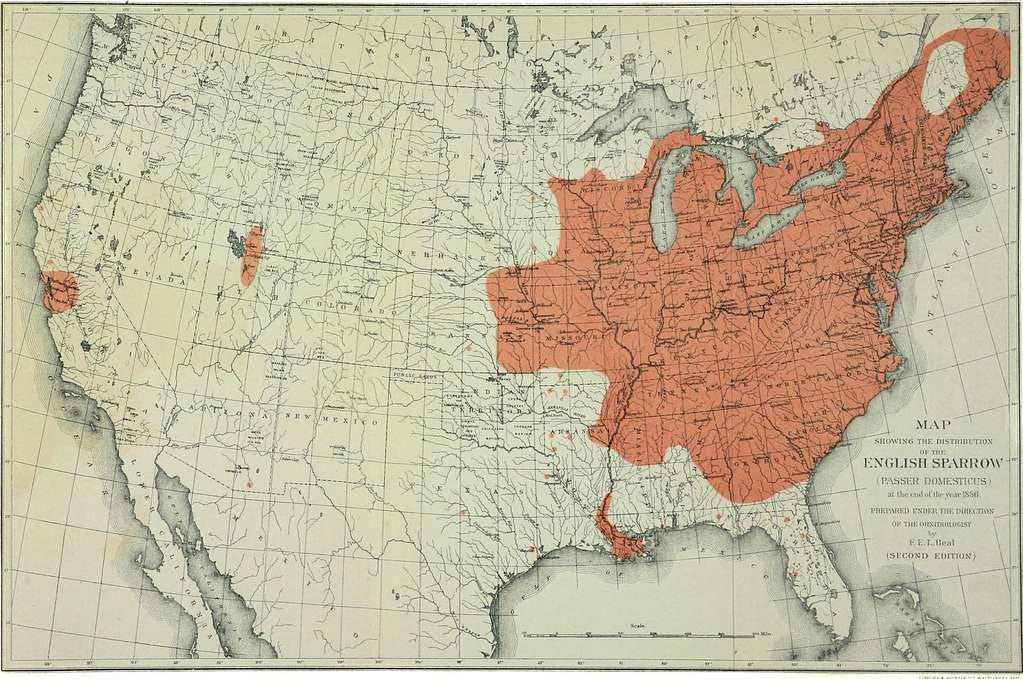
By 1886 the sparrow was found in thirty-five of the thirty-eight states, occupying “the whole or large parts” of thirty-three of them. Since they were first introduced, they had expanded their range at an average rate of 59,000 miles per year—about the size of Illinois. While it took a few decades, by the 1880s ornithologists recognized that they were witnessing something exceptional: “The marvelous rapidity of the Sparrow’s multiplication, the surpassing swiftness of its extension, and the prodigious size of the area it has overspread are without parallel in the history of any bird.”16
Or as the sparrow’s greatest critic, Elliott Coues wrote, “This sturdy and invincible little bird has overrun the whole country.”
It was only then that Americans began to realize that sparrows might be a pest worse than the one they were meant to replace, and that in fact the sparrows had little interest in eating bugs at all. Even worse, they seemed to drive out native birds everywhere they spread. House sparrows became a textbook example of the dangers of species introduction, and in 1900 Congress passed a law banning their importation. But by that point it was far too late.
The sparrow craze is just the beginning of this bird’s troubled history in America. Plenty of others have done a great job writing about what happened next, in particular the so-called Sparrow War that broke out between the bird’s defenders and detractors (here’s a good summary). Last year, I also wrote a piece about how house sparrows were attacked in explicitly nativist terms as unwelcome immigrants displacing native birds. There’s a lot more to say about sparrows, and I might come back to them soon. We’ll see!
Trash Birds

In the 1850s, Brooklyn was beset by a plague of worms. Every spring, as soon as trees began putting on their leaves, these moth larvae would strip the trees bare, hang webs between the branches, and drop onto “hat, bonnet, dress, and person, to the disquiet of everyon…
Invasive species are rightly considered one of the greatest threats to biodiversity. There are countless examples of a single individual releasing cats, or rabbits, or goats, or mongooses that ultimately wreaked havoc on native ecosystems. None of us would ever be so reckless.
But this is not one of those stories. In the 1860s and 1870s, Americans in just about every town wanted house sparrows, and they did everything they could to make their introductions a success. This wasn’t an example of one person’s bad decision. It was a movement, a bad idea that got out of control. There’s no one we can point fingers at, which means there isn’t an easy answer. The country eventually learned its lesson, but only imperfectly, and much too late.
Parrots Gone Wild

Some say they escaped from a broken shipping crate at JFK Airport. Others say they were released by an airport worker who couldn’t bear to see the birds caged up. No one knows for sure how they got here, whether it happened in 1970 or 1968, or whether the escapees numbered in the thousands or the dozens. However it happened, Monk Parakeets have made the…
Welcome to America, Please Try Not to Die

“You would harm no one, and disturb nothing, and never pay off, and never kick back, and never compromise or lose your bearings. You would do it in a new sin-free way, win-win, which of course is also part of the American character, perhaps the most defining part: the notion that, if we were only given one more chance, we could finally get it right.”
Home On The Range

The last time I flew back home to South Dakota, I was struck by the checkerboard of farm quarter sections I saw stretching out to the horizon. The land was divided into clean, neat squares, each as geometric as the state’s boundaries. For all their varying shades of green and brown, I couldn’t help thinking of the farms below as ecological deserts. Mono…
Gentry, Thomas George. The House Sparrow at Home and Abroad: With Some Concluding Remarks Upon Its Usefulness, and Copious References to the Literature of the Subject. United States: Claxton, Remsen, and Haffelfinger, 1878; “City Intelligence.” The Philadelphia Inquirer, May 14, 1869, p. 2.
“English Sparrows.” Buffalo Post, September 10, 1869, p. 4.
“Pests of City Trees.” The Philadelphia Times, July 23, 1879, p. 4; “Summary of the News.” The Philadelphia Inquirer, June 4, 1872, p. 4.
“The English Sparrow.” The Galveston Daily News. December 25, 1869, p. 4; “The Army Worm.” The Atlanta Constitution, June 5, 1869, p. 1.
“Shall We Import the English Sparrow?” Deseret News, May 4, 1870, p. 3.
“A Suggestion to Fruit Growers.” Chico Weekly Chronicle-Record (Chico, California), September 30, 1865, p. 4.
“English Sparrows vs. Mosquitos.” The Hawaiian Gazette, October 19, 1870, p. 3.
“English Sparrows.” The Cleveland Leader, May 23, 1867, p. 2; “English Sparrows.” The Kentucky Gazette (Lexington). March 3, 1870, p. 3.
“Notes and Notions.” The Cincinnati Enquirer, October 3, 1870, p. 4; The Cleveland Leader, September 19, 1870, p. 3.
“English Sparrows for our Sea Islands.” The Charleston Daily News, October 21, 1869, p. 2; “Canary Birds.” The New York Times, April 14, 1869, p. 2.
“The Natural Guardians of Fruit.” Bellows Falls Times (Vermont), June 4, 1869, p. 4; Barrows, Walter. “The English Sparrow in North America, Especially in its Relations to Agriculture.” US Department of Agriculture, Division of Economic Ornithology and Mammalogy, Bulletin 1. United States: U.S. Government Printing Office, 1889.
Ibid.
Ibid.
“The Natural Guardians of Fruit.” Bellows Falls Times (Vermont), June 4, 1869, p. 4.
The Evening Star (Washington, D.C.). March 19, 1870, p. 1; Barrows, Walter. “The English Sparrow in North America, Especially in its Relations to Agriculture.” US Department of Agriculture, Division of Economic Ornithology and Mammalogy, Bulletin 1. United States: U.S. Government Printing Office, 1889; Coates, Peter. American Perceptions of Immigrant and Invasive Species: Strangers on the Land. United States: University of California Press, 2006.
Barrows, Walter. “The English Sparrow in North America, Especially in its Relations to Agriculture.” US Department of Agriculture, Division of Economic Ornithology and Mammalogy, Bulletin 1. United States: U.S. Government Printing Office, 1889.
I love these little guys, who can sometimes cheep so relentlessly and shrilly on a summer's day in my backyard I actually yell at them to knock it off from time to time lol
Would any trip to target be complete without some parking lot sparrows? Seriously though, this was another fascinating read, and what a wild thing to learn—the importance of horse manure in the spread of the English sparrow.