
Home On The Range
Ring-necked Pheasants and their uncomfortable place in South Dakota

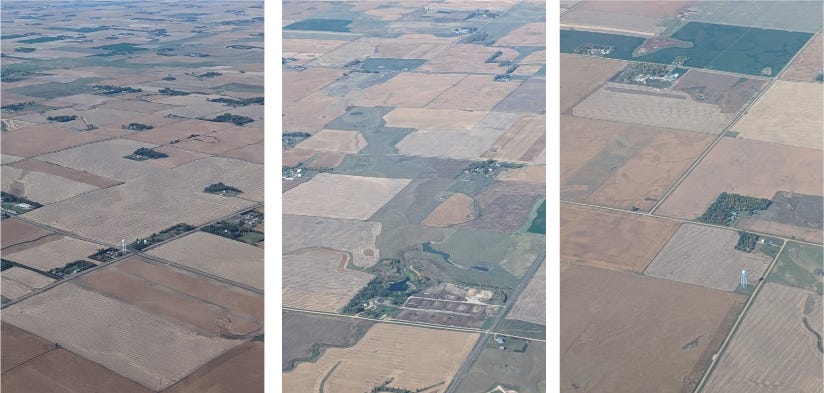
The last time I flew back home to South Dakota, I was struck by the checkerboard of farm quarter sections I saw stretching out to the horizon. The land was divided into clean, neat squares, each as geometric as the state’s boundaries. For all their varying shades of green and brown, I couldn’t help thinking of the farms below as ecological deserts. Monocropping and pesticides made sure that little more could survive on the land than corn and soybeans.
What I saw out my airplane window was a land wiped clean of its native plants, native animals, and native peoples. After massacring the Lakota and imprisoning the survivors on reservations, White settlers slaughtered the bison and plowed up the prairie, replacing them both with commodities that could slot neatly into the national economy. Native game birds fared little better. In 1894 William Sirrine wrote that the prairie’s turkeys, grouse, and prairie-chickens were all “steadily going the disastrous way of the buffalo.”1 This left the settlers needing something they could hunt, an alien bird that could survive in the alien ecological regime they had ushered in.
Americans of means began trying to bring Ring-necked Pheasants to the new world almost as soon as the country was colonized. None of them, including New York’s governor in 1733, George Washington in 1787, and Benjamin Franklin’s son-in-law in 1790, had any success establishing the birds in the wild. It wasn’t until 1880, when the U.S. Consul in Shanghai shipped pheasants from China to his brother in Oregon, that the birds finally made themselves at home.
Oregon’s pheasants multiplied so rapidly that the state officially opened up its birds to hunting in 1892, and on the first day of the season, hunters harvested 50,000 birds. In captivity, pheasant hens can lay as many as 75 eggs in a season, and the game farms that proliferated throughout the country cranked out pheasants by the thousands. The rest of the country was eager to get in on the action, and by 1910 Oregon’s largest game farm had shipped birds to buyers in 28 states.
A dozen of these birds went to Herbert Hagman, Henry Schalkle, and Harland Packard of Redfield, South Dakota in 1910. The pheasants they released into the wild managed to survive the winter, which helped Herbert, Henry, and Harland rally more of Redfield’s hunters to the cause. With their pooled resources they imported another 57 pheasants the following year.2
Their fledgling efforts got the attention of South Dakota’s Game Department, which decided to introduce pheasants at scale. Between 1914 and 1918, the state released another seven thousand birds. By 1919, South Dakota’s game department judged that Redmond’s pheasants were ready for the real test. On October 30, they subjected the pheasants to an inaugural one-day hunting season, where one thousand hunters harvested two hundred birds. From that beachhead, pheasants and pheasant hunting exploded across the state.
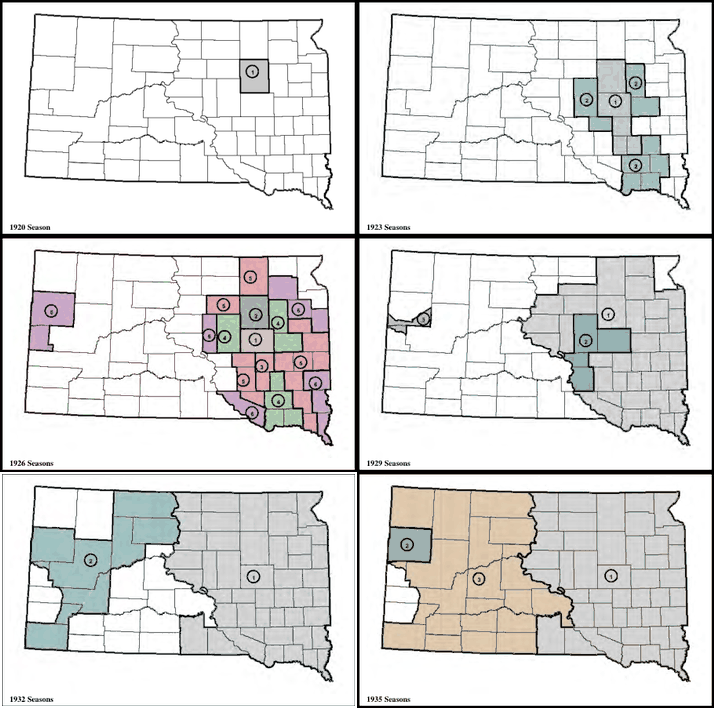
The sort of introductions that established pheasants in South Dakota—small-scale releases by enthusiastic individuals, large-scale liberations by state game departments—were happening all over the United States. But it was only in South Dakota that people made pheasants part of their identity.
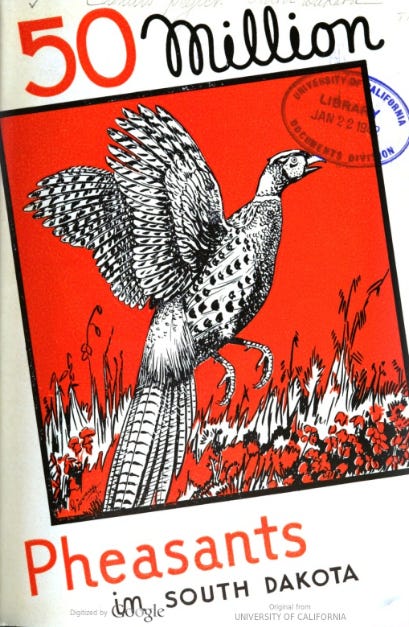
In 1941, Russell Rice estimated that South Dakotans had killed more than 20 million pheasants since they were first introduced. Pheasant season, he wrote, “has become an institution, almost as much a part of fall as corn husking or Thanksgiving.” The town of Redfield branded itself “The Pheasant City” and adopted pheasants as its school mascot. Forty miles north, Aberdeen hosted an annual Golden Pheasant Festival, featuring “a full week of entertainment, agricultural and industrial exhibits, and general merrymaking,” which “celebrates the beginning of the pheasant hunting season.”3
South Dakotans figured out pretty quickly that there was good money to be made from pheasants. The state gained a reputation as the best spot for pheasant hunting in the country and began drawing tens of thousands of visiting hunters each year. Even through the depression, Rice could write that “hotels and rooming houses are crowded to capacity” during pheasant season, while “cafes and restaurants experience a boom, gasoline sales soar to new heights, and stores handling shotgun shells are hard pressed to keep a supply on hand.”4
In 1943, representative Paul Kretschmar proposed that the state make their relationship with pheasants official. In a speech to the state legislature, Kretschmar argued for pheasants to be named South Dakota’s state bird. Just like South Dakotans, he reasoned, pheasants were a hearty mix of immigrant stock. Just like South Dakotans, pheasants had proven able to “weather the hardships” of “droughts, cold and storms.” Just like South Dakotans, the pheasant stayed in the state year round, through weather both foul and fair, unlike migratory songbirds who fled as soon as temperatures plunged. Beyond these parallels, the bird ingratiated itself to the state’s residents by yielding its body as “an excellent table delicacy; a fine sporting bird; it is a source of substantial income to the State.”5 On February 3, 1943, South Dakota’s House of Representatives voted 60 to 7 to adopt pheasants as an official symbol. Two weeks later, the governor signed the bird into law.
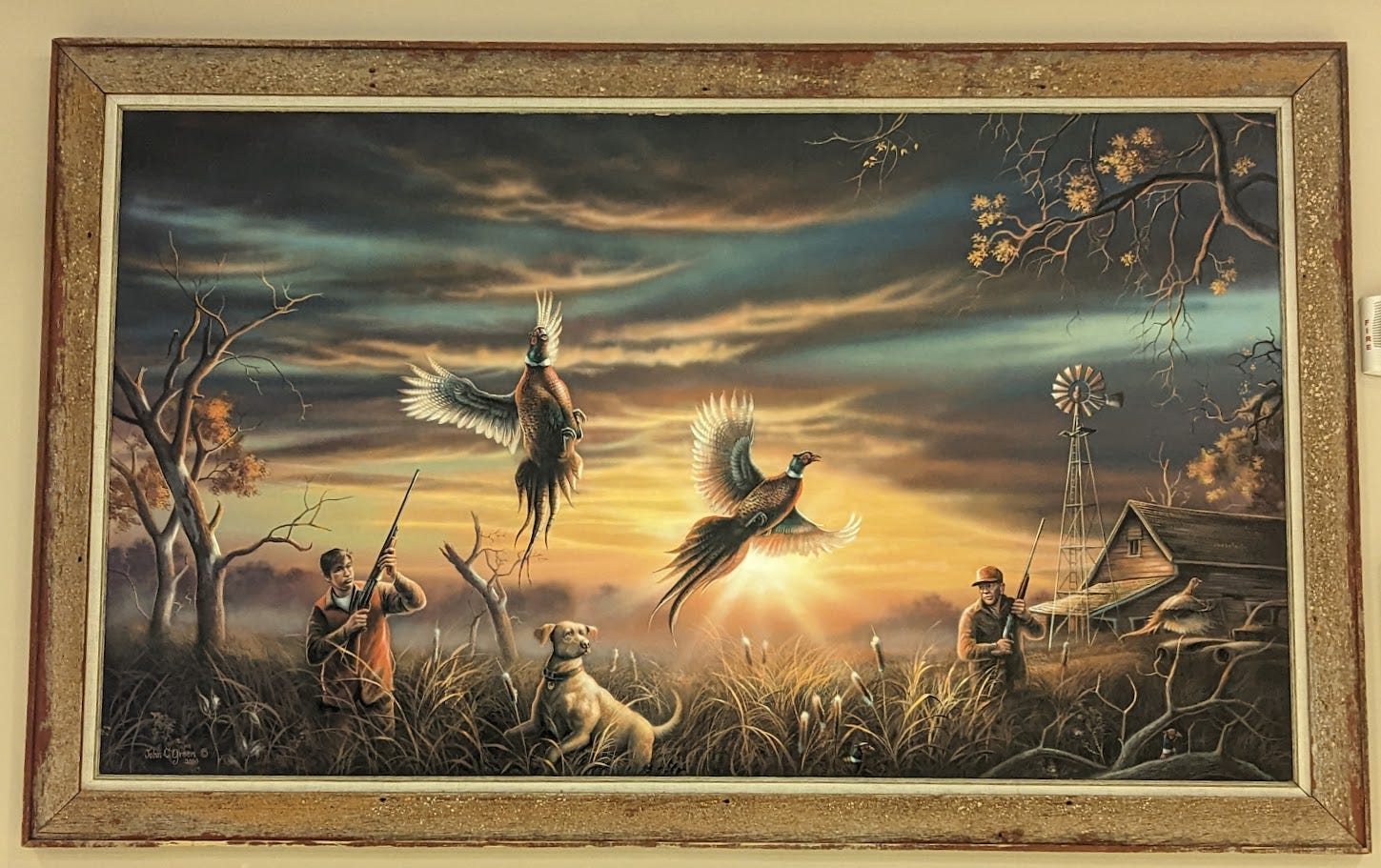
In 1936 Seth Gordon explained what made South Dakota such an ideal habitat for pheasants. Much of the state was “covered with vast cornfields, from which the corn is husked from the stalks, leaving the fodder and the corn missed in harvesting in the fields for winter cover and food. Adjacent to the cornfields are large swamps and sloughs covered with heavy grass and reeds of the kind which pheasants crave for added shelter and roosting cover.”6
On that same land, native turkeys, grouse, and prairie-chickens unfortunately came up wanting. “The case of Eurasian v. American game birds is fully made out,” wrote Waldo McAtee for the U.S. Bureau of Biological Survey in 1929. “The native birds had equal opportunity with the foreign ones to respond to feeding and legal protection, yet with their advantage of close adaptation to country and climate, and priority of occupation, they failed to make good.” Pheasants had become the hunters’ workhorse, coming back stronger after every punishing open season. The “less hardy” native birds, in contrast, were “now objects of care and conservation.”7
Tourism and farming are South Dakota’s two primary industries, and it is a great irony that they stand in conflict with each other. When agriculture suffers, pheasants thrive. The drought and depression of the dust bowl years led many farmers to abandon their land, leaving the ground fallow and expanding pheasant habitat. Many more farmers traded their plows for swords once the United States entered the Second World War. Fuel rationing lowered the number of acres under cultivation, while plentiful rains gave pheasants all the plant cover they needed. And so it was at the expense of agriculture that South Dakota’s pheasants reached their all-time peak of 16 million in 1945.
Their fortune turned as soon as the war ended. Soldiers returned home and returned to tilling the land, but they also brought back their guns and began hunting with a vengeance. A more threatening development occurred when the United States began exporting grain to China and the Soviet Union in the seventies. This increased crop prices and encouraged farmers to cultivate the marginal land that they’d previously neglected—land that pheasants depended on for survival. By 1976 the state’s pheasant population fell to just 1.4 million birds.8
Since then, agriculture has only grown more intensive. Small, messy farms once provided pheasants with an ideal habitat in their fencerows, wetlands, shelterbelts, and field corners, but these have largely disappeared as farms consolidated into massive feedlots and agrobusinesses. Herbicides have cleared pheasants’ cover, and pesticides have killed their insect food. All of these changes work together to turn cropland into an ecological wasteland.
The biggest factor determining America’s pheasant population is the global price of grain. It’s not weather, or predators, or hunters. It’s whether farmers find it worthwhile to grow crops on their least productive land. The difference between pheasants thriving and pheasants disappearing is the difference between farmers cultivating 95 percent or 100 percent of their acreage.
As much tourism and hunting that pheasants bring to the state, there is no question of what South Dakota’s core economic driver really is. Counting revenue from hotels, car rentals, hunting licenses, and deluxe hunting packages, pheasants brought $223 million to the state in 2013. Agriculture, on the other hand, yielded $25.6 billion, more than a hundred times as much.
Even though most pheasants live on private land, public policies determine how intensively that land is cultivated. On one side of the equation, farm subsidies encourage farmers to grow crops on their most marginal acres. On the other side is the Conservation Reserve Program (CRP), a part of the Farm Bill that since 1985 has paid farmers to replace crops with trees and native grasses on erosion-prone and environmentally sensitive land.
Income from CRP alone doesn’t come close to equaling profits farmers stand to make from planting the same land with crops. The Reagan-era initiative pays farmers somewhere from $10 to $300 per acre to leave land fallow, at best a third of what they might make from growing corn. But if that land can also grow pheasants, revenue from hunters can more than make up the difference.
It’s not just pheasants that stand to benefit from the CRP, however. Removing the land from cultivation has a far-reaching impact on native species as well. When farmers convert corn into pollinator meadows, native grasses, and stands of native trees, they create accidental reserves for threatened native birds in the process. America has lost half of its original shortgrass prairie and more than ninety percent of its tallgrass prairie. Longspurs, bobolinks, and harriers all depend on the restoration of these ecosystems.9
Pheasant habitats created on CRP acres fall far short of a pristine, unbroken prairie maintained by bison and fire. Land cultivated for pheasants doesn’t meet the needs of the most threatened species, like the prairie-chickens that pheasants were originally meant to replace. But farmers aren’t making a choice between pheasant habitat and prairie-chicken habitat. They’re choosing between pheasant habitat and soybeans. Farmers can only be expected to preserve native habitat if it is financially competitive with the crops they might instead grow, and for South Dakotans, pheasants are the best way of making that happen.
Today, South Dakota’s pheasant population is as healthy as ever. Partners in Flight estimates the global population of Ring-necked Pheasants at fifty million birds. While this number fluctuates widely from year to year, South Dakota accounts for somewhere between ten and twenty percent of the world population. In 2024, pheasant hunters in South Dakota harvested 1.3 million birds, the highest number since 2011.
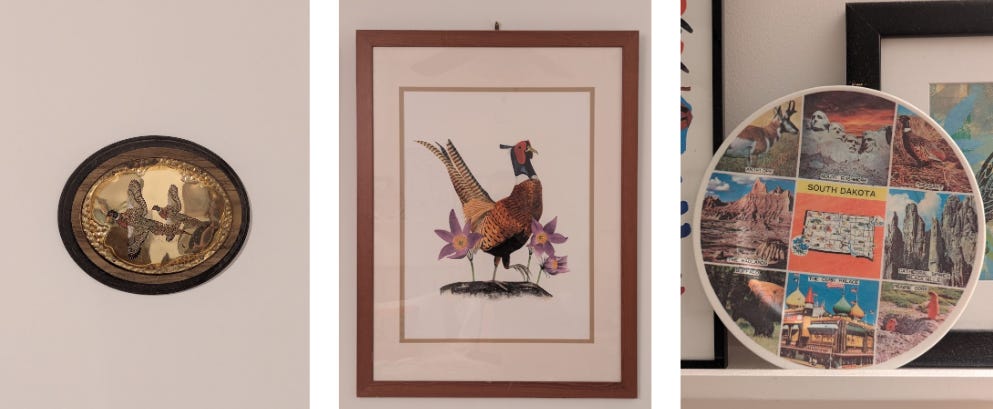
I have an uncomfortable relationship with my home state’s chosen bird. I’m happy to celebrate an introduced species’ complicated past and present, and although I’m not a hunter I think that hunting is one of the most significant and timeless relationships that we can have with wildlife. But to the extent that we treat pheasants as only existing to be hunted, we do them and ourselves a disservice. Although they were brought over for that purpose, and continue to be managed with that goal, they also represent the imperfect equilibrium between the native and non-native, human and non-human communities that exist in conflict and coexistence.
My cynical side is tempted to retort that pheasants have done well in South Dakota in the same sense that cows and chickens have done well. People want pheasants, and South Dakota has figured out better than anywhere else how to produce a lot of them. But this isn’t giving pheasants enough credit. We’ve made the Midwest a game park, but pheasants have made it their home.
I can’t finish a post about South Dakota’s state bird without sending you straight to Amy Stewart’s Substack, It’s Good to Be Here. Right now, Amy’s writing the authoritative book on the movement to create state birds and all of the strange battles and conservation victories that emerged as a result. It should be no surprise that I cannot wait for it to come out. Somehow Amy paints just as well as she writes, and each of her posts comes illustrated in watercolor. Do yourself a favor and subscribe now!
William Sirrine, “Pheasant-Breeding in the United States.” Harper’s Weekly, March 3, 1894, vol. 38, pg. 213
Shafer, Lonnie. “The South Dakota Pheasant Hunting Seasons Data Book.” South Dakota Department of Game, Fish and Parks, Pierre. 2019.
Rice, Russell. “Fifty Million Pheasants: The Story of Game Birds in South Dakota.” Pierre: South Dakota Department of Game and Fish. 1941.
Ibid.
Errington, Frederick, and Deborah Gewertz. "Pheasant capitalism: Auditing South Dakota's state bird." American Ethnologist 42, no. 3 (2015): 399-414.
Gordon, Seth. “The American Pheasant.” Pennsylvania Game News 1936-08: Vol 7 Iss 5.
McAtee, Waldo Lee. Game Birds Suitable for Naturalizing in the United States. United States: U.S. Department of Agriculture, 1929; Rice, Russell. “Fifty Million Pheasants: The Story of Game Birds in South Dakota.” Pierre: South Dakota Department of Game and Fish. 1941.
Laingen, Christopher R., "HISTORIC AND CONTEMPORARY TRENDS OF THE CONSERVATION RESERVE PROGRAM AND RING-NECKED PHEASANTS IN SOUTH DAKOTA" (2011).Great Plains Research: A Journal of Natural and Social Sciences. 1147. http://digitalcommons.unl.edu/greatplainsresearch/1147
Nickens, Edward. “How Prairie Birds Found an Unexpected Group of Heroes in Hunters.” Audubon, Fall 2018. https://www.audubon.org/magazine/how-prairie-birds-found-unexpected-group-heroes-hunters
SO GOOD!!!!!