
Parrots Gone Wild
A global trade in exotic pets brought millions of foreign birds to America. Some of them had other plans.

Some say they escaped from a broken shipping crate at JFK Airport. Others say they were released by an airport worker who couldn’t bear to see the birds caged up. No one knows for sure how they got here, whether it happened in 1970 or 1968, or whether the escapees numbered in the thousands or the dozens. However it happened, Monk Parakeets have made themselves at home in New York City.
On the day I was making my own move to New York, some of these parrots gave me their welcome. As I was picking up a U-Haul across the river in New Jersey, a pair flew screeching overhead, which could only have been a good omen. Now that five months have passed and I’m comfortably settled in Brooklyn, I figured it was time to visit the parakeets on their own turf.
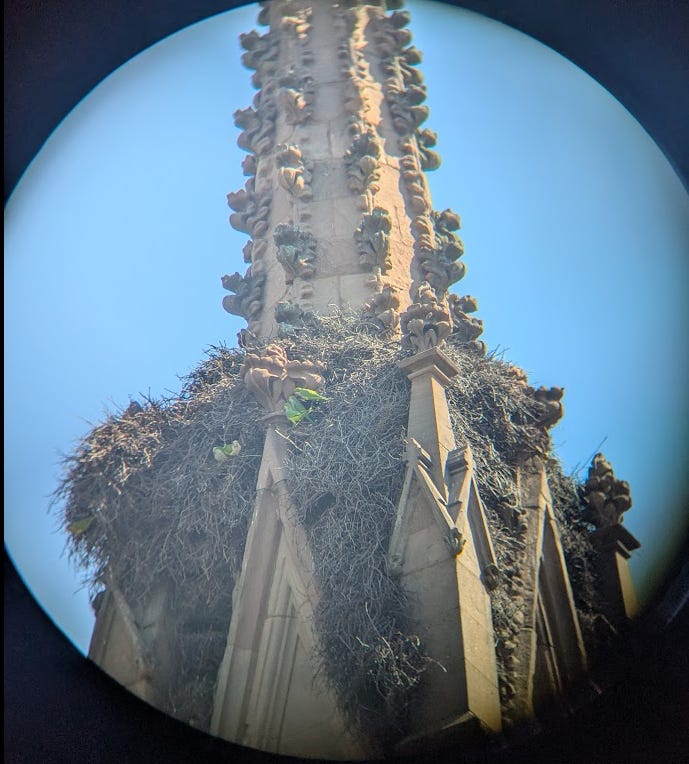
I took a little pilgrimage to Brooklyn’s Greenwood Cemetery last Tuesday to visit the best-known colony of parrots in the city, and they let me know they were there before I’d even stepped inside. I parked my bike and rounded the corner and immediately spotted a trio perched on top of a tall pine tree chattering contentedly.
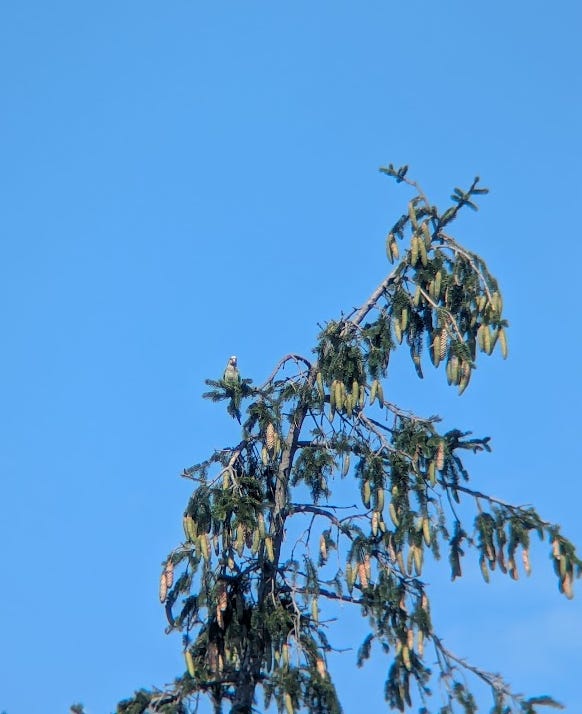
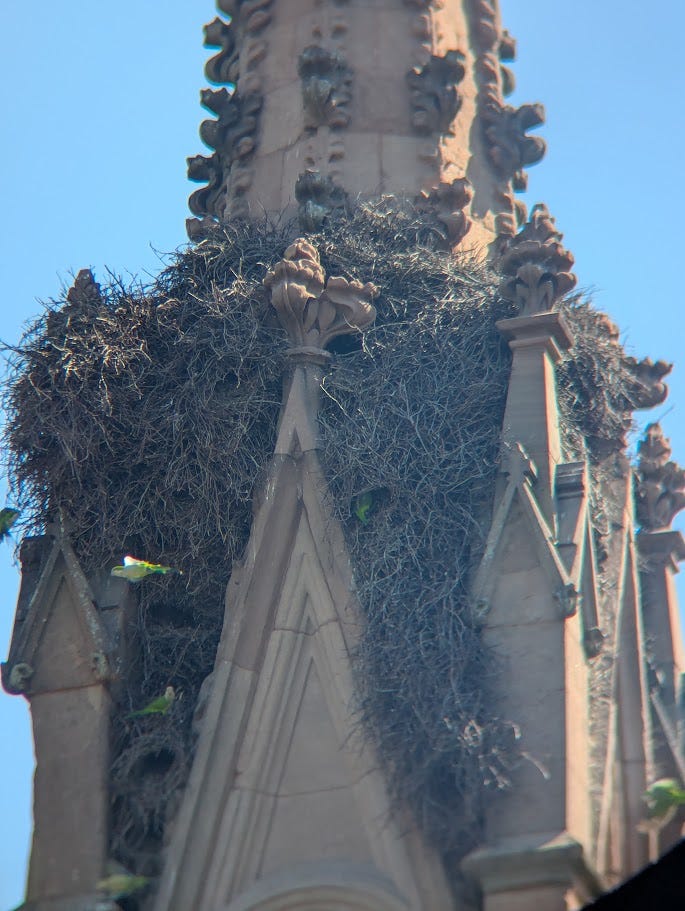

Monk Parakeets are not difficult birds to find. Unlike most parrots, which nest in abandoned tree cavities, Monk Parakeets are unique in constructing massive colonial nests out of sticks. Brooklyn’s parrots chose as their home the giant stone Gothic Revival gate that looms over the cemetery’s entrance, which now sports a messy stick nest that grows from the gate’s tower like a fungus. Every few minutes I saw a different green-and-white parrot poke its head out of one of the many tunnels leading into the nest. I imagine the parrots must be very comfortable inside, and just as comfortable everywhere they’ve brought their architectural blueprints.
There are Monk Parakeet colonies in the Bronx and Queens. Connecticut has parakeets, and so does New Jersey. Boston and Chicago are as un-tropical as it gets, but they have Monk Parakeets too. They’re the most widespread wild parrot in America, but they’re far from the only kind. San Diego is home to nine kinds of parrots, and Los Angeles has fifteen. Twenty species of parrots have been found breeding in Florida. Across the United States there are twenty-five parrot species that have become naturalized, and another thirty-one have been spotted in the wild since 2002.1 But no matter how delightful these birds are, they come with baggage. Every wild parrot in the United States is an unintended remnant of the global pet trade.
Even before the United States was a country, Americans were importing parrots from the tropics. But bringing them over on ships was expensive, especially when so many of the birds didn’t survive the journey. Parrots rarely came in numbers large enough to seed a successful wild colony. An outbreak of parrot fever that sickened hundreds of people and killed dozens in 1929 made the country a lot more cautious about keeping parrots (as Jill Lepore wrote in a fantastic New Yorker article, it also led to the establishment of the National Institutes of Health). Imports fell further when the country sank into the depression and stopped entirely during World War II.
This all changed when the war ended. Air transport routes exploded across the globe, making it feasible to ship hundreds of parrots at a time in voyages measured in hours rather than days or weeks. At the same time, the boom in post-war prosperity opened up exotic pets to a larger array of middle-class families. Before long, the United States was importing hundreds of thousands of parrots every year.
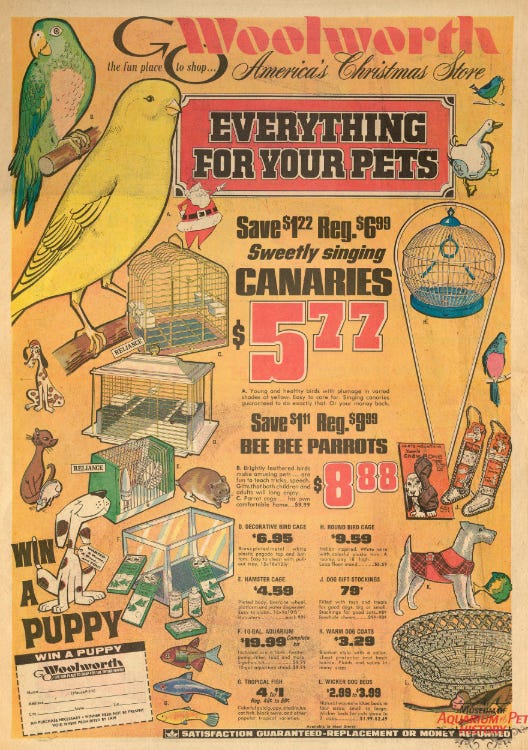
Inevitably, some of these birds escaped. It wasn’t exhausted pet owners releasing one or two parrots at a time that established wild colonies, however. It was cages and crates spilling out entire flocks that rooted parrots in the wild.
The story of every population of wild parrots in America begins in a similar way, with an accident or a fire, with negligence or exasperation. Unlike the acclimatization societies that brought House Sparrows and European Starlings to America, no one intended to establish parrots here.
Intentional or not, the arrival of a new species to a new land seems just as significant spiritually as it is ecologically. Each parrot colony ought to be memorialized with its own Romulus and Remus. Yet another thing these stories have in common is that no one knows for sure how the birds got here. Urban legends are as close as we can get.
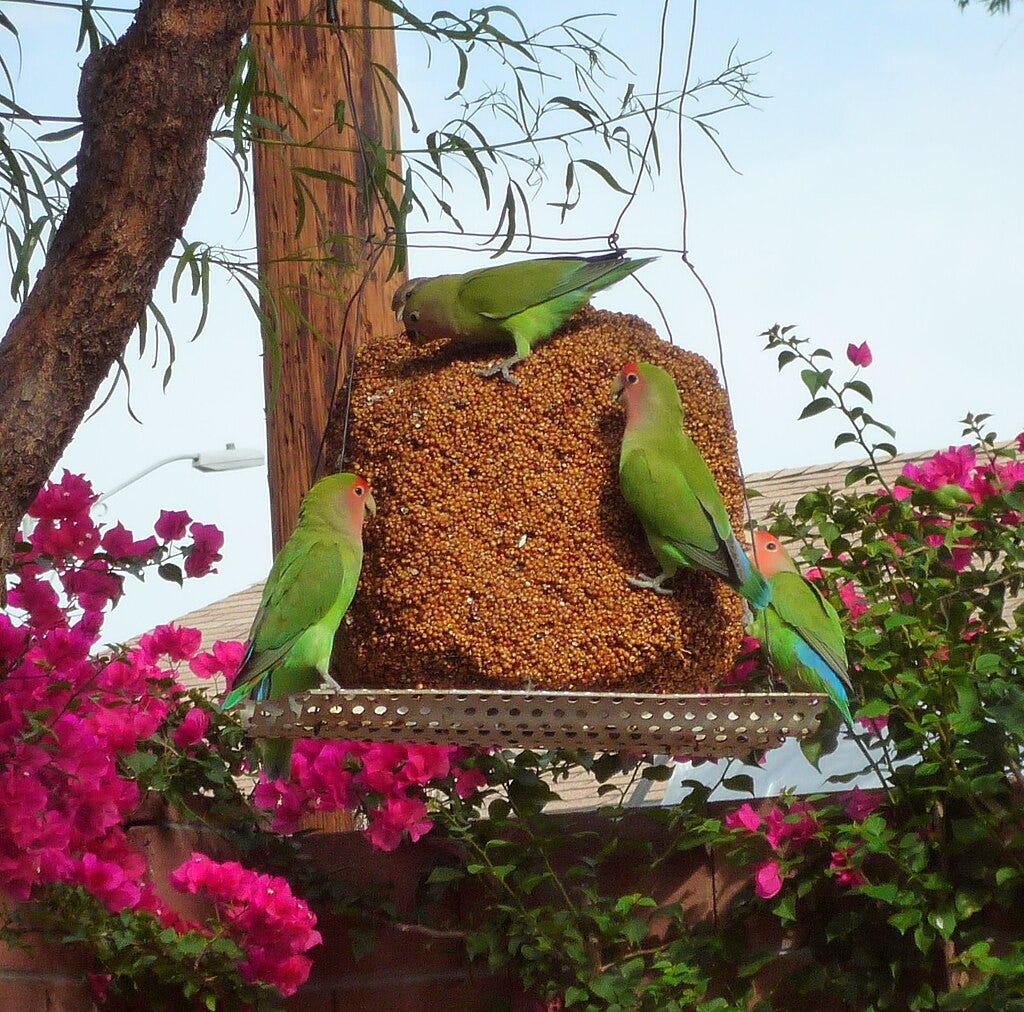
Pasadena’s Red-crowned Parrots probably escaped when a pet store caught on fire and the owner released the birds rather than watch them go up in smoke. Phoenix’s Rosy-faced Lovebirds were probably seeded by a hobbyist releasing a hundred birds after his aviary was hit by a monsoon. San Diego’s parrots might have been released by smugglers carrying birds across the border from Mexico. Some of Los Angeles’s parrots are rumored to descend from birds released when Busch Gardens closed in the 1970s. Others might have been released during the 1992 riots. That, at least, is what people say.2
San Diego, San Francisco, Los Angeles, Miami, and Orlando each have their own unique assortment of parrots for reasons that are more historically contingent than ecological. Miami and Los Angeles have more parrots than anywhere else in America, for example, because those cities were the largest transportation hubs for imported exotic birds. A city’s particular population of parrots is mostly a question of which birds happened to escape.
But it also helped that the residents of these balmy southern cities had stocked their neighborhoods with all the exotic plants these exotic birds needed to survive. Parrots made their nests in non-native palm trees, they ate fruits from non-native ornamental plants. They even learned to frequent birdfeeders for an easy meal. This concentration of assets is found only in urban areas, so that is where the parrots have stayed.
Wild parrots seemed to be a relatively benign presence in the United States. Monk Parakeet nests on telephone poles caused the occasional power outage, but otherwise parrots mostly left crops alone and didn’t compete with native birds for food or real estate. All this time, however, the real damage was accruing in the parrots’ countries of origin. The hundreds of thousands of parrots that Americans imported each year constituted an assault on species that did not have the numbers or resiliency to supply such an aggressive trade.
In response to these ravages on their endemic wildlife, one country after another issued bans on exporting wild birds. Mexico, for example, passed an export ban in 1982, but living next to the world’s largest bird importer meant that there was still good money to be made from smuggling. In 1986 the Department of Justice estimated that more than 150,000 birds crossed the U.S–Mexico border illegally every year. Elsewhere, smugglers moved birds through countries that did not have export bans. Venezuela simply shipped its birds through Guyana, Gambia shipped its birds through Senegal, and Brazil shipped its birds through Argentina.3
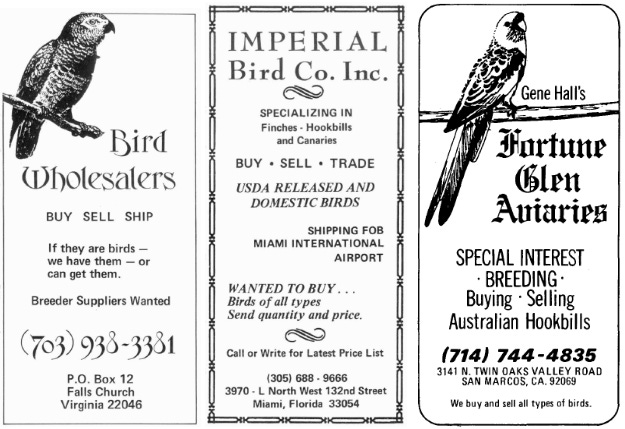
Belatedly, American conservationists began to recognize the impact of the pet trade on global parrot populations, while animal rights activists raised the alarm that the wild parrot trade inflicted a shocking amount of animal cruelty. Capturing nestlings, holding them in cramped and unsanitary conditions, shipping them thousands of miles by air, and then isolating them for months in quarantine proved to be extremely hard on little bird bodies. As many as sixty percent of trafficked parrots died between being taken from the wild and their eventual sale, and more than 330,000 died in transit or in quarantine between 1985 and 1990.4
Following lobbying from conservation organizations, New York passed a law banning the sale of wild-caught birds in 1984 and New Jersey did the same seven years later. Major pet store chains decided to no longer sell wild-caught birds, while all of America’s airlines and scores of foreign carriers determined that they would no longer transport wild-caught birds for market. A 1991 New York Times op-ed warned any reader thinking about buying a parrot to interrogate the pet store owner to make sure their birds were captive-bred.
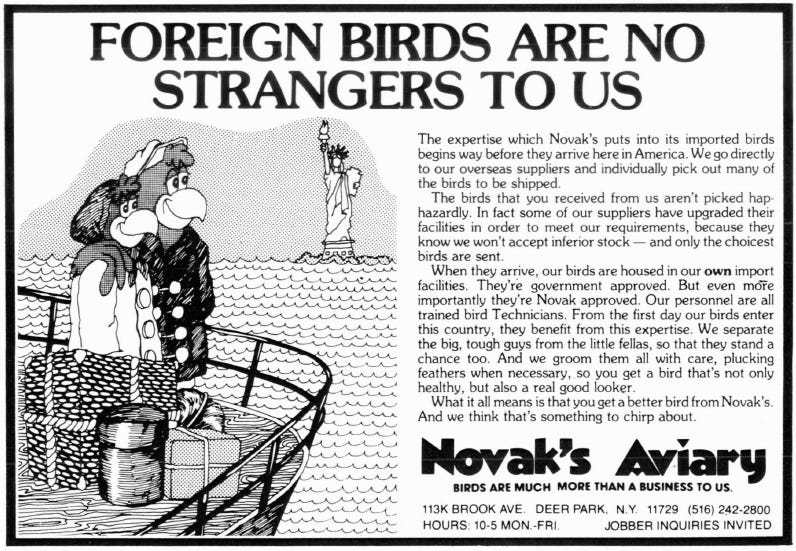
But the bird trade didn’t disappear as these concerns became more widely known; in fact it only got bigger. Imports of wild birds peaked between 1986 and 1988, when nearly two million birds, 43 percent of which were parrots, entered the United States from 85 different countries of origin. As late as 1991 the United States was still importing 800,000 birds a year, at least half of which were parrots, making it the largest market for birds in the world.
On July 31, 1992, James Wyerman walked into the U.S. Capitol accompanied by a Goffin’s Cockatoo. Wyerman had come to D.C. to testify in favor of the Wild Bird Conservation Act, a piece of legislation that would all but eliminate the country’s commercial bird trade. As he sat before the thirteen senators who made up the Senate Subcommittee on Environmental Protection, he explained the damage America’s appetite for exotic birds was doing to the world’s wildlife.
The Goffin’s Cockatoo in the committee room was a captive-bred bird, explained Wyerman, but more than 70,000 Goffin’s Cockatoos (known to ornithologists as Tanimbar Corellas) had been imported from Indonesia’s Tanimbar Islands between 1983 and 1989. So many birds were being stolen from their nests that the species was at risk of going extinct within the next five years. Nearly all of the Goffin’s Cockatoos were destined for the United States as a result of what Wyerman called “Baretta Syndrome,” a surge in demand for five species of cockatoos that looked like the one owned by the titular detective in the television show Baretta. Each of these cockatoo species was now at risk of extinction, and it was solely because of America’s demand for pet birds.

The same story was playing out with dozens of other birds the world over. As Wyerman explained, “consumers in this country have unknowingly fueled a global pet trade that threatens the extinction of many bird species, causes the suffering or death of millions of individual birds and undermines the laws of many foreign countries.”5
Fortunately, these arguments resonated with politicians on both sides of the aisle. When President George H. W. Bush signed the bill into law three months later, he praised it for helping “to prevent any further decimation of wild bird populations.” The law’s effect was nearly immediate. From one year to the next, parrot imports fell from the hundreds of thousands to just a few hundred. It also took the bottom from the global market in birds. Between 1990 and 1999, the number of parrots sold by the five biggest bird-exporting countries (Argentina, Guyana, Indonesia, Senegal, and Tanzania) fell from 245,000 to just 57,000.6
The Wild Bird Conservation Act closed a fifty-year period of aggressive and large-scale dislocation of the world’s avian biodiversity. More birds were forcibly migrated during those years than at any other time in history. The twenty-five kinds of parrots that eventually became established in American cities represent just a fraction of the species that were ultimately imported. An estimated ten million parrots from more than a hundred different species were brought to the United States. And those are just the parrots. The U.S. imported birds representing a staggering 1,540 species from 72 different countries between 1968 and 1972 alone.7
The longing for exotic pets, and the industries it gave rise to, left the world with a new and unpredictable geography of avian life. Millions of birds were shipped across oceans that they were never meant to cross. Thousands of species were dispersed around the world according to the whims of fashion. And then the large-scale, legal, and commercial trafficking of birds suddenly came to a halt, like a song abruptly ending during a global game of musical chairs. Parrots were left to thrive wherever they were planted.
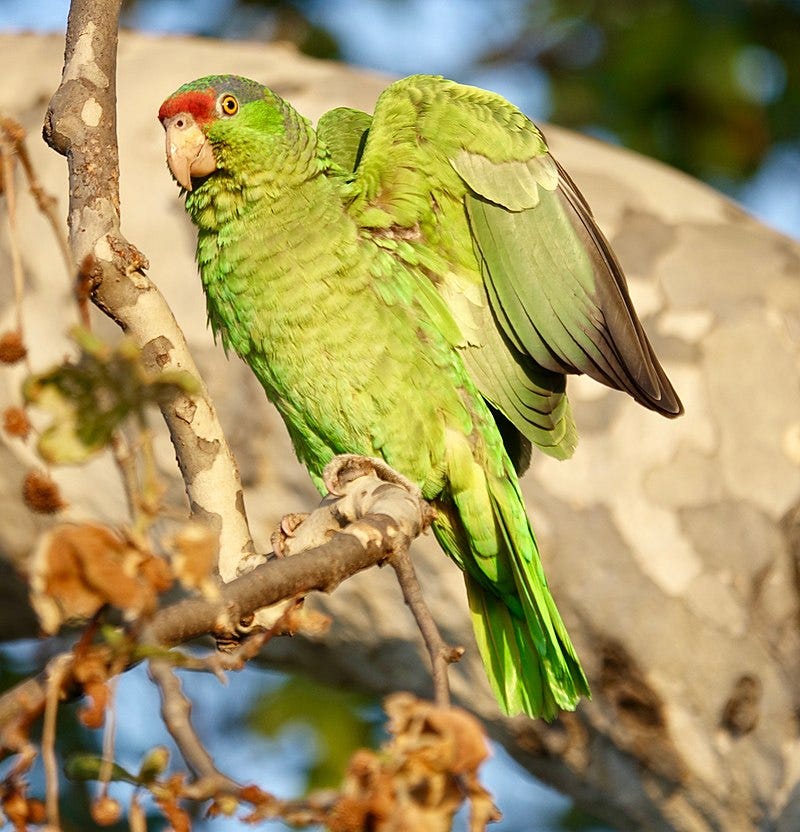
It’s a challenging irony that the parrots now scattered across the United States constitute a genetic reservoir for birds who are threatened with extinction in their original range. More Red-crowned Amazons live in Los Angeles and Texas than in their native Northeastern Mexico. Yet the global trade in parrots is precisely the reason that so few Red-crowned Amazons are left. The status of Goffman’s Cockatoos, the other Baretta parrots, and dozens of species more is just as precarious. Nearly a third of the world’s 374 species of parrots are considered vulnerable or endangered.
A year ago, I wrote a three part series about the Carolina Parakeet and its extinction in 1918. I can’t help but wonder if it might have been saved if there had been a similar genetic reservoir in some other country. Instead, we lost our one widespread native species of parrot—and gained at least twenty-five new ones. The Carolina Parakeet called North America home for five million years. We can only wonder what these new arrivals will make of this land in another five million.
Handa, Lesley. “The Naturalized Parrots of San Diego County.” Sketches, San Diego Audubon, Vol. 72, No. 2. November/December 2020; Conroy, Gemma. “Exotic Parrot Colonies Are Flourishing Across the Country.” Audubon, June 5, 2019.
Volentine, Jason. “Wild parrots can be spotted in Phoenix neighborhoods.” ABC15 Arizona. April 4, 2018; Iovenko, Chris. “How These Parrots Went from the Tropical Jungle to the Concrete Jungle.” National Geographic, December 13, 2023.
Johnston, Georgann. “Confiscated.” AFA Watchbird Magazine. Vol 30, No. 3. 2003; Conservation of Exotic Wild Birds: Hearing Before the Subcommittee on Environmental Protection of the Committee on Environment and Public Works, United States Senate, One Hundred Second Congress, Second Session, on S. 1218 and S. 1219 ... July 31, 1992. United States: U.S. Government Printing Office, 1992.
Ortiz-von Halle, B. (2018). Bird’s-eye view: Lessons from 50 years of bird trade regulation & conservation in Amazon countries. TRAFFIC, Cambridge, UK.
Conservation of Exotic Wild Birds: Hearing Before the Subcommittee on Environmental Protection of the Committee on Environment and Public Works, United States Senate, One Hundred Second Congress, Second Session, on S. 1218 and S. 1219 ... July 31, 1992. United States: U.S. Government Printing Office, 1992.
Bush, George H. W. “Statement on Signing the Wild Bird Conservation Act of 1992.” October 23, 1992. Online by Gerhard Peters and John T. Woolley, The American Presidency Project; Runde, Douglas E.; Pitt, Will C.; and Foster, J. T., "POPULATION ECOLOGY AND SOME POTENTIAL IMPACTS OF EMERGING POPULATIONS OF EXOTIC PARROTS" (2007). Managing Vertebrate Invasive Species. 42. https://digitalcommons.unl.edu/nwrcinvasive/42
Banks, R. C., U.S. Fish and Wildlife Service. (1976). Wildlife importation into the United States, 1900-1972. Washington, D.C.: U.S. Dept. of the Interior, Fish and Wildlife Service.
Holy crap, I had no idea there were that many species of parrot in the US!! Thanks for another enlightening piece, Robert
This is real news to me, thanks for researching this topic, gives a whole new slant on world trade. 🐦⬛ 🪿 🦆 🐥 🦉